Knee pain has a way of changing more than the knee.
You may start taking the stairs differently, using your arms more to get out of a chair, avoiding kneeling, or thinking twice about a long walk. Sometimes these changes are obvious. Others happen so gradually that you barely notice how much your movement has changed.
For people living with knee osteoarthritis (OA), pain and stiffness can affect mobility, physical function, and everyday activities. But an arthritic knee doesn’t necessarily mean the answer is to move less.
Research on yoga for knee osteoarthritis points toward a more interesting possibility: yoga can combine strengthening, mobility, and balance with mindfulness, breathing, meditation, and relaxation. Rather than asking a painful knee to conform to a particular pose, practices can be adapted around the person—their body, symptoms, goals, and what they want to keep doing.
Is Yoga Good for Knee Osteoarthritis?
Research suggests that yoga can help improve pain and physical function for people with knee osteoarthritis.
Studies have explored several approaches, including Hatha yoga, chair yoga, yoga designed specifically around the mechanics of the knee, and integrated yoga therapy. Across these approaches, researchers have reported improvements in areas including OA-related knee pain, stiffness, mobility, walking, and physical function. Reviews of multiple studies have also found evidence supporting yoga for pain and function in people with osteoarthritis.
The practices haven’t all looked alike. Some programs included standing and weight-bearing postures. Others used chairs extensively. Props and adaptations were common. Many combined physical practice with breathing, meditation, or relaxation.
In other words, research on yoga for knee arthritis isn’t pointing toward one perfect sequence. It points toward a practice that can be adapted to help people continue moving and using their bodies.
Yoga for Knee Arthritis: Strength, Movement & Mindfulness
Yoga programs studied for arthritis have incorporated strengthening and weight-bearing movement, mobility, flexibility, balance, breath practices, relaxation, meditation, and body awareness. A 2024 review found that effective yoga programs for osteoarthritis commonly combined physical postures with breathing and/or meditation or relaxation. Props and adaptations were also common.
A practice might ask the muscles surrounding the knee and hip to work in one moment, challenge balance in another, and later shift toward breathing, mindfulness, or relaxation. Yoga gives us tools for working with physical capacity while also addressing some of the ways we experience and respond to persistent pain.
This is also where yoga therapy can offer something different. Rather than focus solely on the knee, it considers the hips and ankles, muscle strength, balance, nervous system, sleep, stress, attention, and the emotional impact on the individual living with pain.
How Yoga Can Help Knee Pain
When your knee hurts, moving it more may not be the first thing that sounds appealing. But for knee pain related to osteoarthritis, appropriately adapted movement can be an important part of staying mobile and maintaining function, and research supports yoga as one way to do that.
Yoga may help knee pain in several ways at once. Strengthening the muscles of the legs and hips can better support everyday movements such as walking, climbing stairs, and getting out of a chair. Mobility practices keep the knee and surrounding joints moving through comfortable ranges. Balance work supports steadiness, while mindfulness, breathing, and relaxation offer additional tools for working with the experience of persistent pain.
Research on people with knee osteoarthritis has found improvements in pain, stiffness, walking, and physical function following yoga programs. These benefits have been seen across different approaches, including Hatha yoga, chair yoga, and yoga specifically adapted to strengthen the lower body while managing how much load is placed on the knee.
Yoga for knee pain doesn’t have to mean avoiding the knee or only doing gentle stretches. Depending on the person, it can include strengthening, weight-bearing movement, balance, mobility, and periods of rest or mindfulness. A chair, wall, blocks, straps, or a change in stance can make a movement more appropriate without removing its purpose.
And there isn’t one “best” yoga pose for knee pain. A movement that feels useful for one person may not be appropriate for another, and knee pain can come from many causes besides osteoarthritis. New, severe, worsening, or unexplained pain should be evaluated rather than assuming that a yoga practice will address it.
For someone with osteoarthritis, though, the research gives us good reason to move beyond the idea that a painful knee simply needs to be protected from movement. The goal is to find movement the knee can work with and build from there.
Strength Matters—Especially as We Age
Pain relief matters, but so does maintaining the physical capacity to live your life.
Getting out of a chair, climbing stairs, carrying groceries, walking across uneven ground, gardening, getting down to the floor, and catching yourself when you lose your balance all require muscular strength.
This becomes increasingly important as we age.
Sarcopenia is the age-related loss of muscle mass and strength. Research has found it more frequently among people with knee osteoarthritis than among people without it. That doesn’t tell us that one causes the other. Pain and reduced activity may contribute to muscle loss, reduced muscle capacity may affect the knee, or the relationship may work in both directions.
There’s also good reason not to view that loss as inevitable or irreversible.
A review of 19 studies found that older adults with osteoarthritis of the knees or other lower-body joints could increase measures of muscle mass and size through strengthening exercise.
Yoga research adds another piece. Across 15 studies involving more than 2,500 adults age 60 and older, yoga was associated with improvements in muscle strength, balance, and flexibility.
We don’t yet have evidence showing that yoga prevents age-related muscle loss in people with knee OA, but what the research does challenge is the assumption that having osteoarthritis means the body has lost its capacity to become stronger.
Pain Can Change the Way We Move
Pain is a physical experience, but it can also change how we approach movement.
If bending your knee has hurt repeatedly, you may become cautious about bending it. If balance feels less reliable, you may think differently about stairs, uneven ground, or standing on one leg. Sometimes those adaptations are useful. Sometimes they gradually narrow the amount or variety of movement in daily life.
Some of the knee OA research suggests that yoga may affect this part of the experience too.
In one study, older adults practicing yoga reported less fear of falling than participants receiving health education. Another trial studied chair yoga specifically among adults with arthritis in the knees, hips, feet, or ankles who were unable to participate in standing exercise. During the intervention, participants experienced improvements in pain, the degree to which pain interfered with their lives, fatigue, and walking speed.
This is one reason adaptation can be so useful.
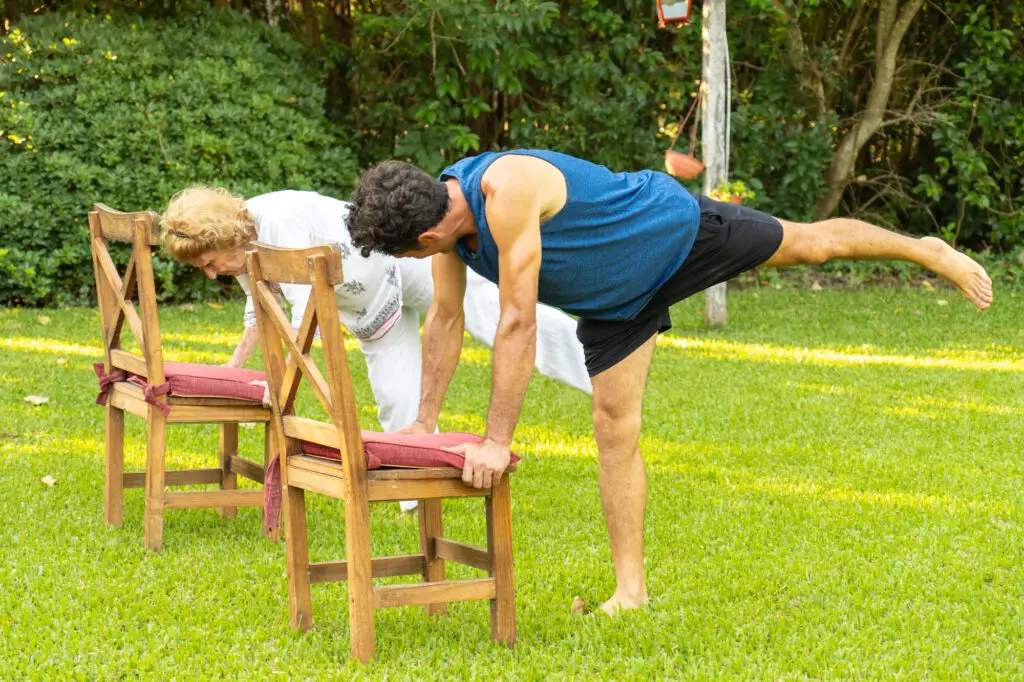
Take Warrior II. One person might use a shorter stance. Another might bend the front knee less deeply. Someone else might use a chair for support, change how long the pose is held, or explore several versions and notice how each feels.
Adaptation isn’t a lesser version of yoga. It is part of learning how to work with your body.
Over time, that process may also create opportunities to explore a question that interests me as a yoga therapist: not simply What movements can I perform? but How confident am I in my ability to move?
We need more research before drawing conclusions about yoga, knee OA, and confidence in movement specifically. But it is an important question when the larger goal is continuing to move and participate in daily life.
More Than Yoga Poses: Working With the Whole Experience of Pain
If you search for yoga for knee pain, you’ll find plenty of lists of poses.
A pose can be useful. But yoga therapy doesn’t begin and end with finding the right shape for the knee.
Physical practice might include sit-to-stand or Chair variations for functional strength, supported Warriors for lower-body strength and mobility, Bridge or leg lifts, supported Tree for balance, and comfortable movement through the ankles, knees, hips, and spine. Research protocols for arthritis have included many of these kinds of movements, often with chairs, walls, straps, blocks, or blankets used to change stability, range of motion, or how much weight or effort is placed through the knee.
But persistent pain also involves attention, emotion, expectation, and behavior. Mindfulness gives us a way to notice sensations and our responses to them. Breath practices may help us work with tension and arousal. Meditation and relaxation create space for practices that aren’t focused on strengthening or improving physical performance.
These practices don’t make structural changes in a joint disappear. They offer additional ways of working with the experience of living in a body that sometimes hurts.
That distinction is important. Yoga therapy isn’t necessarily asking, Which pose fixes knee pain?
It can ask a much larger question:
What might help this person move, function, adapt, and live well with the body they have?
Santoṣa & Svādhyāya: Accepting a Changing Body
Yoga philosophy offers another way into that question.
Santoṣa, one of the niyamas described in yoga philosophy, is commonly translated as contentment. It can be easy to mistake contentment for resignation: This is my knee now. I guess I just have to accept it.
But acceptance and resignation aren’t necessarily the same thing.
Santoṣa can invite us to acknowledge what is true in the present without demanding that the body be different before we can be at ease with it.
A knee may not bend as far as it once did. A chair may make a particular movement more useful. Walking three miles may not be realistic today.
None of those observations tells us everything the body will be capable of tomorrow.
Svādhyāya, another niyama, is traditionally associated with self-study. Within a yoga practice, that orientation toward inquiry can encourage us to notice not only physical sensations but our responses to them.
What happens when discomfort appears? Do I become curious? Frustrated? Afraid? Do I immediately stop moving? Push harder? Compare today’s body with the body I had ten years ago?
The point isn’t to find the correct response. It is to become more aware of the relationship we’re developing with a changing body.
Perhaps the question becomes:
Can I acknowledge what is true about my body today without assuming that today determines everything that will be possible tomorrow?
Santoṣa can coexist with strengthening. Acceptance can coexist with change.
How Much Yoga Is Enough?
Research doesn’t yet give us a neat prescription.
Programs for knee osteoarthritis have varied in class length, frequency, intervention length, and expectations for home practice. Some involved multiple supervised sessions each week. Others combined a weekly class with shorter practices at home.
In a study of women ages 65 to 90 with knee OA, 74% reported that they were still practicing yoga at the 20-week follow-up. But none were maintaining the frequency and duration originally prescribed by the study.
That raises a practical question researchers haven’t fully answered:
How much practice is enough to be beneficial while still being realistic enough to continue?
What works during a structured eight-week study isn’t necessarily what someone wants—or is able—to maintain for years.
For yoga therapy, sustainability matters. A practice can evolve as symptoms, strength, interests, goals, and life circumstances change.
What Might Whole-Person Yoga Therapy for Knee Pain Look Like?
There isn’t one established yoga therapy sequence for knee pain, nor should every session revolve around the knee.
A session might begin simply by noticing what is present that day: pain or stiffness, energy, sleep, mood, recent activity, and what the person hopes to be able to do.
Mindfulness or body awareness might help someone explore physical sensations and notice how they respond to them. Svādhyāya, or self-study, can extend that inquiry beyond the physical sensation itself.
Movement might then involve the whole body rather than repeatedly targeting the painful joint. Mobility at the ankles and hips can accompany comfortable movement at the knee. Functional movements such as getting up from a chair can become strengthening practices. Supported standing poses can work with strength, balance, and confidence. Props, range of motion, repetitions, and the amount of weight placed through the joint can change from one person—or one day—to another.
Breath practices, meditation, or relaxation might be incorporated depending on what is useful. Yoga philosophy might offer another lens for exploring pain, aging, expectations, or the relationship someone has developed with their body.
And eventually, the practice should connect back to life outside the yoga session.
Maybe the goal is climbing stairs more comfortably. Maybe it’s continuing to garden, walking the dog, hiking, traveling, getting onto the floor with grandchildren, or simply feeling less apprehensive about movement.
The purpose of the practice isn’t to become particularly good at Chair Pose.
It’s to support the life the person wants to keep living.
What We Still Don’t Know
The research on yoga and knee osteoarthritis is encouraging, but there are still important unanswered questions.
Studies use different styles of yoga, different schedules, different combinations of practices, and different measures of success. We need more information about long-term outcomes, sustainable amounts of practice, which parts of yoga contribute to particular benefits, and whether yoga can contribute to maintaining muscle mass as people age.
There are also questions that aren’t always captured well by standard measures: Does practice change someone’s confidence in movement? Does learning to adapt movement help people remain active? What makes someone continue practicing six months or several years later?
Those questions are important because living well with osteoarthritis isn’t an eight-week intervention.
Supporting the Ability to Keep Moving
Knee osteoarthritis can change the way we move. It doesn’t necessarily mean that movement, strength, or meaningful physical activity must steadily disappear.
Research on yoga for knee OA supports potential benefits for pain, stiffness, mobility, balance, strength, and physical function. Yoga therapy can build on those findings while considering something research measures less easily: the whole person who happens to have the knee.
That might mean strengthening one day and meditation another. It might mean changing a familiar pose, learning a new way to get off the floor, noticing fear around a particular movement, or reconsidering assumptions about what aging is supposed to look like.
Healthy aging doesn’t require an unchanging body.
It asks us to keep developing a relationship with the body we have—and to remain curious about what it may still be capable of.
References
Biswas, S., et al. (2024). Key characteristics of effective yoga interventions for managing osteoarthritis: A systematic review and meta-analysis.
Cheung, C., et al. (2014). Yoga for managing knee osteoarthritis in older women: A pilot randomized controlled trial.
Cheung, C., et al. (2017). Managing knee osteoarthritis with yoga or aerobic/strengthening exercise programs in older adults: A pilot randomized controlled trial.
Ko, et al. (2023). Effects of yoga on physical and psychological health among community-dwelling older adults: A systematic review and meta-analysis.
Kuntz, A. B., et al. (2018). Efficacy of a biomechanically-based yoga exercise program in knee osteoarthritis: A randomized controlled trial.
Liao, C. D., et al. (2020). Effects of muscle strength training on muscle mass gain and hypertrophy in older adults with osteoarthritis: A systematic review and meta-analysis.
Park, J., et al. (2017). A pilot randomized controlled trial of the effects of chair yoga on pain and physical function among community-dwelling older adults with lower extremity osteoarthritis.
Pegreffi, F., et al. (2023). Prevalence of sarcopenia in knee osteoarthritis: A systematic review and meta-analysis.