
The holidays have a remarkable way of bringing the past into the present. The scent of evergreen, the familiar sound of a holiday song, or the sight of an ornament carefully unwrapped from tissue paper can transport us to another time in our lives. These experiences can evoke warmth and nostalgia, but they can also remind us of people, relationships, and chapters of our lives that are no longer with us.
Psychologist J. William Worden describes four tasks of mourning: accepting the reality of our loss, processing the pain of grief, adjusting to a world without the deceased, and finding an enduring connection with the deceased while embarking on a new life. Rather than prescribing a series of emotional stages, Worden’s framework recognizes the active and deeply personal ways we engage with grief. Although developed in the context of bereavement, many of these themes resonate with other experiences of significant loss. The teachings and practices of yoga offer a variety of ways to engage with these experiences across the different dimensions of our being.
Grief is as much a part of the human experience as love. Although we often associate grief with the death of someone dear to us, we may also grieve the end of a relationship, changes in our health or physical abilities, estrangement from family, the loss of a beloved animal companion, or a future we once imagined for ourselves. During a season so intimately connected with relationships, memories, and traditions, the distance between what once was and what is now can feel especially pronounced.
Yoga offers a rich and compassionate framework for exploring grief. Its teachings recognize the interconnectedness of our physical, energetic, emotional, intellectual, and spiritual experiences, offering many different avenues through which we can care for ourselves, express our emotions, and explore our changing relationship with life.
Understanding the Whole-Person Experience of Grief
We may recognize grief most readily through our emotions, but its presence often extends far beyond sadness or longing. It can change the way we breathe, sleep, move, think, and relate to others. Activities that once brought us pleasure may lose some of their appeal, and familiar places may feel strangely unfamiliar. We may find ourselves questioning our beliefs, reconsidering our priorities, or wondering who we are outside of a relationship or role that once helped define us.
These experiences are rarely independent of one another. A sleepless night can intensify our emotional sensitivity, while a meaningful conversation or a walk in the fresh air may shift our energy, ease physical tension, and offer a different perspective on something we have been struggling with.
Yoga has long been explored as a supportive practice for navigating grief and loss. Research examining the relationship between physical activity and bereavement suggests that practices such as yoga may offer opportunities for emotional expression, support psychological well-being, and foster social connection (Williams et al., 2021).
The Five Koshas: Exploring the Layers of Our Being
Rooted in the teachings of the Taittiriya Upanishad, the five koshas (pancha kosha) describe five interconnected layers, or sheaths, of human experience. Beginning with the physical body, they extend inward through increasingly subtle dimensions of our being.
In contemporary yoga therapy, the koshas offer a framework for understanding the whole person and exploring how different yoga practices may support different aspects of well-being. When we apply this framework to grief, we begin to see the many ways loss touches our lives, as well as the many possibilities for nurturing ourselves as we move through it.
Working With Grief Through the Five Koshas
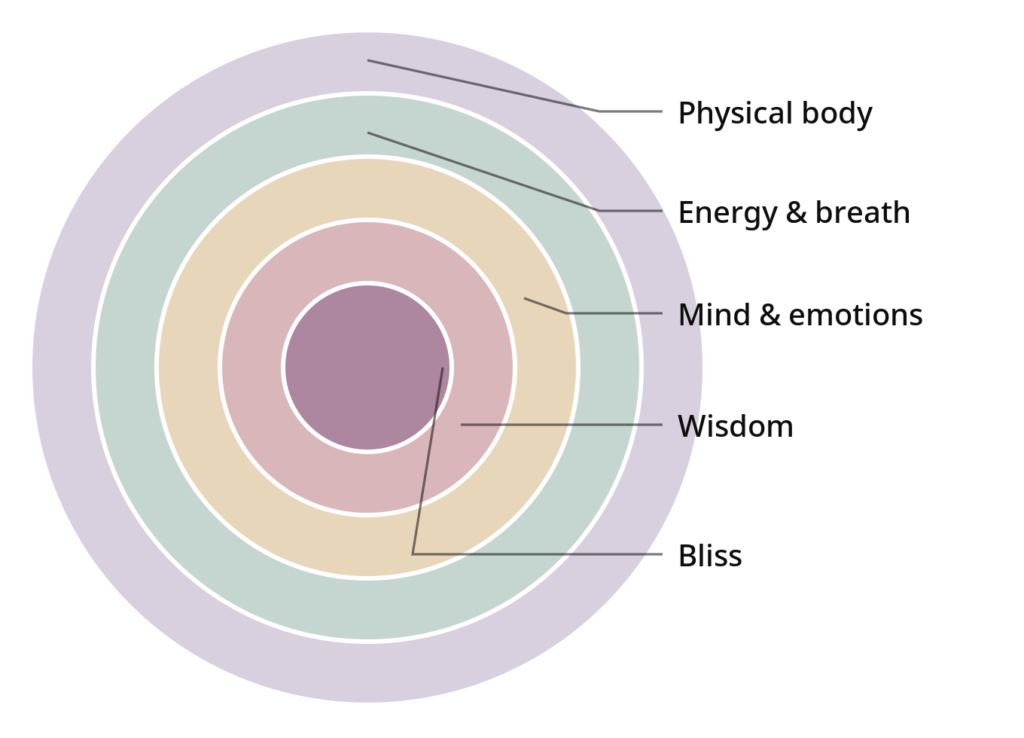
The Physical Body (Annamaya Kosha): Finding Comfort and Support
There is a physicality to grief that can be difficult to put into words. We may experience an aching sensation in our chest, a heaviness in our limbs, tightness in our throat, or a weariness that seems disproportionate to the activities of the day. Our sleep and appetite may change, and even familiar everyday tasks can require an unexpected amount of effort.
During the holidays, we may place additional demands on our bodies without fully recognizing how much energy we are already expending. Traveling, preparing for gatherings, and navigating changes in our routines can leave us feeling particularly depleted.
Working with the physical body invites us to become curious about what our bodies are communicating and what forms of care might feel genuinely nourishing. A supported restorative yoga posture may offer an opportunity to experience warmth, comfort, and physical steadiness. Gentle somatic movement can help us explore areas of tension, while walking outdoors may reconnect us with the sensory richness of the world around us. Even something as simple as feeling the weight of a blanket across our body can provide a tangible experience of comfort.
The body can also serve as an anchor when our emotional experiences feel particularly intense. Bringing our attention to the physical sensations of our feet on the ground, the support of a chair, or the texture of an object in our hands can help orient us to our immediate surroundings.
Supportive yoga practices: Restorative yoga, gentle somatic movement, supported relaxation, sensory touch, and body scans.
An invitation to explore: Find a comfortable spot and get cozy with a plush or weighted blanket. Notice the texture of the blanket against your skin, its warmth, softness, and gentle weight. Adjust the blanket so it comforts you, allowing yourself to settle in. Perhaps stretch your legs, gently roll your shoulders, or curl up a little more. Take a few minutes to savor the physical sensations of warmth, comfort, and support.
The Energetic Body (Pranamaya Kosha): Honoring the ebb and flow of vitality
In yoga philosophy, the energetic body is associated with vital energy (prana), the life force that animates us and is intimately connected with our breath.
Grief can profoundly change our experience of vitality. There may be days when we feel as though our inner spark has dimmed, when getting out of bed or engaging in activities we once enjoyed requires considerable effort. At other times, we may feel drawn toward familiar activities, creative projects, or the company of others. The Dual Process Model of Grief, developed by Margaret Stroebe and Henk Schut, recognizes this natural oscillation between attending to our loss and adapting to the ongoing experiences and demands of life. As we move between these experiences, we may notice corresponding shifts in our energy, breathing patterns, and desire for movement, rest, or connection.
The practices of yoga offer many ways to explore and respond to these fluctuations in energy. Gentle breathing practices may feel supportive when we are restless or overwhelmed, while rhythmic movement, sound, or a more invigorating yoga practice may appeal to us when we are feeling withdrawn or depleted. Our needs may change considerably from one day to the next.
Exploring the energetic body can also help us become more discerning about where we direct our energy. During the holidays, we might notice which relationships and activities leave us feeling nourished and which require more of us than we have available. This awareness can help us make choices that reflect our present circumstances rather than relying on familiar patterns or expectations.
Supportive yoga practices: Natural breath awareness, gentle breathwork (pranayama), humming, rhythmic movement, and breath-led yoga.
An invitation to explore: Find a comfortable spot, perhaps with some soft music playing in the background. Take a few moments to settle in, noticing the natural rhythm of your breath and the quality of your energy. Begin to breathe in and out for an even count of four. After several rounds, experiment with different breathing rhythms. If you’re feeling restless, try gradually extending your exhale to a count of six. If you’re feeling sluggish, try a brief, comfortable pause after each inhale before gently exhaling. Keep your breath relaxed and unforced as you explore these variations. Return to your natural breathing rhythm and notice any subtle shifts in your energy, alertness, or sense of calm.
The Mental and Emotional Body (Manomaya Kosha): Making Space for Our Inner Experience
Grief encompasses an extraordinary range of emotions. Alongside sadness and longing, we may experience anger, relief, guilt, gratitude, resentment, tenderness, loneliness, and even joy. Some of these emotions may surprise us or challenge our understanding of what grief is supposed to feel like.
Our minds may revisit conversations, replay memories, imagine different outcomes, or wander into questions that have no satisfying answers. During the holidays, we may find ourselves comparing present experiences with cherished memories of the past or becoming absorbed in thoughts about how things might have been.
Two of Worden’s tasks of mourning involve accepting the reality of our loss and processing the pain of grief. Meditation offers one way to gently engage with these experiences. Rather than following every thought into its accompanying story, we might notice how an emotion moves through the body, how a memory influences our breathing, or how different feelings arise and coexist within us. Truthfulness (Satya) can guide this exploration, inviting us to acknowledge the complexity of our emotional experiences with honesty and compassion.
There are also times when our emotions seem to extend beyond what words can express. Movement, sound, poetry, painting, and other forms of creative expression offer additional ways to engage with grief. A spontaneous movement or an image that emerges while drawing may give expression to something we have struggled to articulate. Creative practices may also bring us into contact with memories, feelings, and aspects of ourselves that have received little attention.
For some people, quiet meditation may be particularly difficult during periods of grief. Keeping the eyes open, engaging in gentle movement, or exploring the senses may offer a more accessible way to practice present-moment awareness.
Supportive yoga practices: Guided meditation, compassionate emotional awareness, expressive movement, mantra, reflective writing, and embodied creativity.
An invitation to explore: Set aside a few quiet moments with a journal and a pen. Begin by asking yourself, “What am I feeling today?” Write freely for a few minutes, allowing your thoughts and emotions to find their way onto the page without editing or judging them. You may discover that several emotions are present at once. As you finish writing, take a moment to notice how you feel. Is there a particular emotion asking for your attention, or perhaps something you’ve been longing to express? Allow yourself to acknowledge whatever emerges with honesty and compassion, honoring the practice of truthfulness (Satya).
The Wisdom Body (Vijnanamaya Kosha): Exploring Identity and Meaning After Loss
Some of the most profound experiences of grief involve questions of identity and meaning. Who am I now? What matters to me? Where do I belong? How do I envision a future that looks so different from the one I had anticipated?
Our relationships, roles, abilities, and experiences contribute to our understanding of who we are. When we experience a significant loss, we may find ourselves grieving not only what we have lost but also a version of ourselves that existed within those circumstances. The loss of a partner, for example, may change our experience of companionship, our daily rhythms, and our understanding of the future. A change in physical ability may alter how we express ourselves, participate in activities, or experience independence.
Worden identifies adjusting to a world without the deceased as another task of mourning. This adjustment extends beyond the practical responsibilities of everyday life to our understanding of who we are, what we believe, and how we experience the world. The wisdom body, associated with insight, discernment, and deeper understanding, offers a valuable lens through which to explore these changes. Through practices such as self-study (Svadhyaya), we can begin to examine our beliefs, values, assumptions, and the stories through which we make sense of our evolving lives.
This perspective shares some common ground with contemporary grief researcher Robert Neimeyer’s work on meaning reconstruction, which recognizes the ways significant loss can challenge our understanding of ourselves and the world. Making meaning does not necessarily involve finding a reason for our loss. It may instead involve exploring how we carry our experiences forward, how our understanding of life evolves, and what continues to matter to us.
The holidays can offer a particularly poignant opportunity for this kind of reflection. Traditions we once participated in almost automatically may take on new significance. Some may become more precious, while others may no longer reflect who we are or how we wish to spend our time. We may feel drawn toward new experiences that express something meaningful about the people we are becoming.
Supportive yoga practices: Self-study (Svadhyaya), contemplative meditation, philosophical inquiry, reflective writing, and values exploration.
An invitation to explore: Gather a few objects, photographs, or mementos that represent meaningful people or chapters in your life. Take some time to explore the stories and memories associated with each one. Reflect on or share with someone how these relationships and experiences have shaped your values, interests, beliefs, and understanding of yourself. Perhaps someone inspired your love of music, your sense of adventure, or your generosity toward others. Through the practice of self-study (Svadhyaya), consider how these qualities live within you today. Choose one that you would like to express more intentionally in your life and explore a meaningful way to bring it into your holiday season.
The Bliss Body (Anandamaya Kosha): Discovering Love, Connection, and Wholeness
Of the five koshas, the bliss body may seem the most difficult to reconcile with grief. The word bliss suggests happiness, yet within yoga philosophy, it points toward something more profound than the pleasure we experience when life unfolds as we hope.
We might approach this dimension of our being through experiences of deep connection, love, peace, and wholeness.
Loss can challenge our sense of connection to the world around us. We may feel disconnected from our communities, from the natural world, from our spiritual beliefs, or even from ourselves. Experiences and places that once evoked a sense of belonging may become reminders of what is missing. We may also find ourselves drawn toward spiritual questions we had rarely considered before.
And yet, grief and deep connection can exist within the very same experience. Listening to a loved one’s favorite piece of music may evoke both tears and an extraordinary sense of closeness. Spending time in a familiar landscape may awaken memories while also reconnecting us with the beauty of the present moment. There can be a tenderness in these experiences that is difficult to describe as either sorrow or joy alone.
Worden’s fourth task of mourning involves finding an enduring connection with the deceased while embarking on a new life. This shares common ground with the contemporary grief theory of continuing bonds, which recognizes that our relationships with those who have died can continue to evolve through memories, traditions, values, and the ways their presence has shaped our lives. For some, this connection may also have a deeply spiritual quality. The love we carry can continue to find expression in our creativity, relationships, choices, and the ways we participate in the world.
Yoga offers contemplative, devotional, and experiential practices through which we can explore these different dimensions of connection. Meditation, Yoga Nidra, time in nature, and meaningful personal rituals can provide opportunities to reflect on the relationships and experiences that continue to enrich our inner lives.
Supportive yoga practices: Yoga Nidra, contemplative meditation, devotional yoga (Bhakti Yoga), remembrance rituals, and contemplation in nature.
An invitation to explore: Spend a few moments in a place where you feel a deep sense of connection, perhaps beneath a favorite tree, beside a body of water, or in a quiet corner of your home. Close your eyes, if comfortable, and bring to mind someone whose love has enriched your life. Recall a moment of shared laughter, tenderness, or quiet companionship. Rather than focusing on the details of the memory, explore the feeling of love itself. Perhaps place your hands over your heart and imagine that love radiating throughout your body. Spend a few moments immersing yourself in this experience of connection, welcoming whatever emotions arise.
Satya: Honoring the Truth of Our Grief
Truthfulness (Satya) is one of the ethical principles, or yamas, outlined in Patanjali’s Eight Limbs of Yoga. Although often understood in relation to honesty in our interactions with others, Satya also invites us to explore the relationship we have with our own inner experiences.
The holidays can be accompanied by an abundance of expectations about how we should feel, what we should do, and how we should relate to one another. There may be pressure to create a joyful atmosphere, maintain family traditions, or participate in celebrations that hold very different meanings for us than they once did. We may find ourselves performing a familiar version of ourselves while privately navigating a complicated emotional landscape.
Practicing Satya might mean acknowledging that we genuinely want to celebrate the holidays this year, even though we are grieving. It might mean recognizing that a tradition we have cherished for decades now feels painful, or that beneath our desire for solitude is a longing for meaningful connection. Sometimes the truth of our experience is complicated, and our feelings may change considerably from one moment to the next.
Honoring the truth of our grief also means acknowledging the other experiences that continue to unfold alongside it. We may spend part of an afternoon immersed in memories and another part laughing with friends, decorating our home, or becoming absorbed in a creative project. These moments of pleasure and engagement are also part of the truth of our experience. They reflect our continuing capacity for connection, creativity, and participation in life, even as we carry the pain of loss.
Our capacity to experience joy does not diminish the depth of our love or the significance of our loss.
Practicing truthfulness during the holidays might involve:
- Recognizing which traditions bring us comfort and which no longer feel meaningful.
- Being honest about our physical and emotional energy.
- Acknowledging our desire for companionship, solitude, or a different kind of connection.
- Expressing our grief through conversation, creativity, movement, or personal ritual.
- Welcoming moments of genuine pleasure and enjoyment when they arise.
When practiced alongside non-harming (Ahimsa), Satya invites us to approach these truths with gentleness. We can become increasingly aware of our needs and desires while respecting the complexity of our emotional experiences.
A Guided Yoga Meditation for Grief: Truth and Gentle Return
Inspired by the yogic principle of truthfulness (Satya), this guided meditation invites you to gently acknowledge your emotional experience while reconnecting with your breath, physical body, and the support beneath you.
The practice begins by establishing an awareness of physical support before gradually exploring three of the five koshas.
Mental and Emotional Body (Manomaya)
Gently acknowledging the truth of your emotional experience.
Energetic Body (Pranamaya)
Reconnecting with the natural movement and rhythm of your breath.
Physical Body (Annamaya)
Returning to tangible sensations of physical presence, contact, and support.
Throughout the meditation, you are invited to move between awareness of your inner experience and the physical sensations of contact with the surface beneath you. These points of contact offer a place to return whenever inward attention becomes uncomfortable or emotionally intense.
You may wish to practice with a blanket, bolster, or other supports that allow your body to rest comfortably. You are welcome to keep your eyes open, adjust your position, or orient yourself to your surroundings throughout the practice.
Yoga practices can complement other meaningful forms of grief support, including conversations with trusted friends, community gatherings, grief support groups, and professional mental health counseling.
Honoring Our Loss While Continuing to Embrace Life
There is something deeply personal about the way we carry our experiences of loss into the changing seasons of our lives. We may preserve traditions that remind us of someone we love, adapt others to reflect our present circumstances, and gradually discover new ways of finding meaning and connection. A familiar holiday ritual may become an act of remembrance, while an entirely new experience may awaken a part of ourselves we had almost forgotten.
The wisdom of the five koshas reminds us that there are many ways to engage with this experience. Some days we may find comfort in physical warmth and rest. On others, we may feel drawn toward movement, creative expression, companionship, or quiet spiritual reflection. Each offers a different avenue for tending to our relationship with ourselves and the world around us.
As you move through the holidays, consider what it might mean to honor the whole of your experience, including the relationships that have shaped you, the losses you carry, and the things that continue to awaken your curiosity, affection, and enthusiasm for life.
A reflection for the season
- What would it look like to honor the truth of my experience this holiday season?
- What memories, traditions, or expressions of love would I like to carry forward?
- What is stirring within me that I would like to nurture?
Our lives continue to unfold around the people and experiences that have shaped us. The love we have known may find expression in the way we care for others, the things we create, the traditions we preserve, and the possibilities we choose to explore. Grief becomes part of an evolving human experience that can also hold beauty, tenderness, discovery, and moments of extraordinary joy.
References & Further Reading
Traditional Yogic Texts
- Easwaran, E. (Trans.). (2007). The Upanishads (2nd ed.). Nilgiri Press.
- Taittiriya Upanishad, Brahmananda Valli.
- Patanjali. Yoga Sutras, II.30–36 and II.44.
Yoga Therapy
- Helbert, K. (2015). Yoga for grief and loss: Poses, meditation, devotion, self-reflection, selfless acts, ritual and prayer to help heal your grief. Singing Dragon.
- Sausys, A. (2014). Yoga for grief relief: Simple practices for transforming your grieving mind and body. New Harbinger Publications.
- Stang, H. (2014). Mindfulness & grief: With guided meditations to calm your mind and restore your spirit. CICO Books.
Contemporary Grief Theory & Research
- Klass, D., Silverman, P. R., & Nickman, S. L. (Eds.). (1996). Continuing bonds: New understandings of grief. Taylor & Francis.
- Neimeyer, R. A. (Ed.). (2001). Meaning reconstruction & the experience of loss. American Psychological Association.
- Stroebe, M., & Schut, H. (1999). The dual process model of coping with bereavement: Rationale and description. Death Studies, 23(3), 197–224.
- Worden, J. W. (2018). Grief counseling and grief therapy: A handbook for the mental health practitioner (5th ed.). Springer Publishing Company.