

Have you ever become so absorbed in something that, for a little while, you seemed to forget yourself?
Perhaps you were creating, playing music, moving, or immersed in a conversation with someone who knows you well. Time passed without your noticing. The usual commentary in your mind grew quiet. You were no longer wondering how you appeared, whether you were doing it correctly, or what needed to happen next.
There was only the experience itself.
Moments like these can feel rare, but they often carry a sense of recognition—as though beneath the roles we perform, the thoughts we follow, and the worries we carry, there is something more spacious and whole.
Yogic philosophy has long been interested in what obscures that experience and what helps reveal it. One way it approaches this inquiry is through the koshas, five interconnected sheaths through which human life is experienced.
The koshas are often introduced as five “layers” of the self: the physical body, energy, mind, wisdom, and bliss.
The Sanskrit word kosha is commonly translated as sheath, covering, or veil. Rather than suggesting separate compartments, the image is one of something gently wrapped or enclosed, revealing some aspects while obscuring others. Together, they describe dimensions of human experience ranging from the tangible physical body to the far more elusive experience of bliss.
They also point toward one of yoga’s deeper questions:
What remains when the habits, distractions, identifications, and fluctuations that usually define us begin to grow quieter?
What Are the Five Koshas?
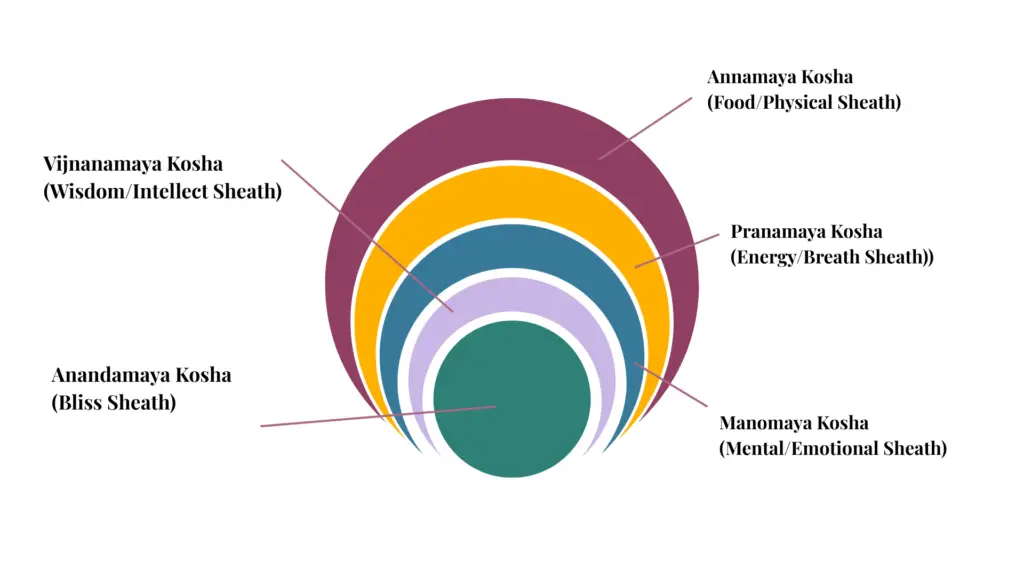
The five koshas appear in classical yogic philosophy as increasingly subtle sheaths:
- Annamaya Kosha — the physical or food sheath
- Pranamaya Kosha — the vital energy or breath sheath
- Manomaya Kosha — the mental and sensory sheath
- Vijnanamaya Kosha — the wisdom or discernment sheath
- Anandamaya Kosha — the bliss sheath
They are often illustrated as concentric layers, with the physical body on the outside and increasingly subtle aspects of experience within.
Yet the koshas are not five isolated compartments. We do not leave the physical body behind when we pay attention to the breath, nor do our thoughts exist separately from sensation, vitality, judgment, or emotion. The sheaths continually influence and permeate one another.
You may already recognize this in your own life.
A movement practice can settle mental agitation. A change in breathing can influence how you meet a stressful moment. Deep rest may bring greater clarity. A recurring belief can affect the way you carry your body. A meaningful insight may change not only what you think, but how you live.
The koshas offer a way of seeing these experiences as expressions of one interconnected human life.
Annamaya Kosha: The Physical or Food Sheath
Anna means food. Annamaya Kosha is the sheath composed of and sustained by food: the material body of bones, muscles, organs, tissues, and skin.
It is the most tangible of the five koshas. We can see it, touch it, nourish it, move it, and observe its changes over time.
Calling it the “food sheath” reflects more than the simple fact that the body needs nourishment. The body is formed from the material world and continually depends upon it. Food becomes tissue. Water becomes part of the blood and cells. The body grows, changes, ages, and eventually returns to the same natural world that sustains it.
This sheath includes many of the experiences people most readily associate with yoga:
- physical strength and mobility
- tension and ease
- hunger and fullness
- pain and comfort
- fatigue and restoration
- movement and stillness
Practices such as asana, rest, nourishment, sleep, and attentive movement engage Annamaya Kosha directly.
Yet even a practice that begins with the physical body rarely stays there. A slow movement may change the breath. Releasing muscular effort may alter the mood. Learning to sense the body more clearly may reveal a habit or emotion that was previously difficult to recognize.
The physical sheath is therefore not merely a vehicle to discipline or perfect. It is one of the primary ways we encounter ourselves and the world.
Pranamaya Kosha: The Vital Energy or Breath Sheath
Within the physical sheath, yogic philosophy describes a subtler dimension called Pranamaya Kosha.
Prana is commonly translated as life force or vital energy. Breath is one of its clearest expressions, but prana is not understood as identical to the air entering and leaving the lungs. It refers more broadly to the animating vitality of life—the force associated with movement, circulation, activity, and aliveness.
Pranamaya Kosha includes the breath and the patterns through which energy moves and is expressed.
You may notice this sheath when:
- your breath becomes shallow during a tense moment
- a long exhale helps you feel steadier
- fatigue leaves you feeling depleted even when your muscles are capable of continuing
- excitement creates a sense of expansion or movement
- a period of rest restores more than physical strength
- breathing, humming, or rhythmic movement changes your internal state
Pranayama, or the conscious cultivation and regulation of breath, works intentionally with this dimension. So do many forms of movement, chanting, Yoga Nidra, and meditation.
In contemporary language, breath practices are sometimes explained only through their effects on physiology and the nervous system. Those effects matter, but the traditional idea of prana is broader. It asks us to notice not only the mechanics of respiration, but the felt quality of vitality itself.
What gives energy?
What drains it?
Where does life feel restricted, scattered, abundant, or steady?
Pranamaya Kosha invites awareness of the rhythms that animate the physical form.
Manomaya Kosha: The Mental and Sensory Sheath
Manomaya Kosha is usually described as the mental sheath, but “mind” can be misleading if it suggests only deliberate thought.
This kosha includes manas: the aspect of mind that receives sensory information, forms impressions, reacts, desires, worries, remembers, and moves rapidly from one experience to another. It is closely connected to emotion and to the ways we interpret what we see, hear, feel, taste, and touch.
A sound is heard.
A bodily sensation is noticed.
A memory appears.
The mind labels the experience, associates it with the past, anticipates what might happen next, and produces a response—often before we have consciously chosen one.
Manomaya Kosha includes:
- thoughts and mental commentary
- emotional reactions
- sensory impressions
- preferences and aversions
- habitual stories
- attention and distraction
- the ongoing construction of “I,” “me,” and “mine”
A thought can alter the breath. A remembered conversation can create physical tension. A strong sensory environment can leave someone agitated or depleted. In the other direction, movement, breathing, rest, or meditation may make the mind feel less crowded.
Yoga does not necessarily ask us to stop thinking or treat the mind as an enemy. It helps us become more aware of its movements.
Through practices such as sensory awareness, concentration, meditation, mantra, and self-observation, thoughts and emotions can be experienced without automatically accepting each one as the whole truth.
The aim is not to become empty or unfeeling. It is to recognize the mind as one sheath of experience rather than the entirety of who we are.
Vijnanamaya Kosha: The Wisdom or Discernment Sheath
Vijnanamaya Kosha is frequently translated as the “wisdom body,” although it is better understood as the sheath of deeper knowledge, intellect, judgment, and discernment.
This is not simply intelligence in the sense of storing information or solving problems. It is the capacity to perceive more clearly, distinguish between competing impulses, recognize patterns, and act with greater awareness.
Manomaya Kosha may react:
I feel uncomfortable, so I need to escape.
Vijnanamaya Kosha can pause and inquire:
What is this discomfort communicating? Is leaving the wisest response, or is an old pattern being activated?
This sheath is associated with:
- insight
- ethical judgment
- intuition
- discernment
- self-reflection
- values
- the ability to witness mental activity
- choosing a response rather than moving automatically
Vijnanamaya Kosha is also where the wider path of yoga becomes especially important.
The Eight Limbs of Yoga are not simply a progression from physical poses toward meditation. Together, they cultivate the conditions for clearer perception. The ethical teachings of the yamas and niyamas ask practitioners to consider how they live. Asana and pranayama develop steadiness and sensitivity. Pratyahara turns attention inward. Concentration and meditation allow the activity of the mind to be seen with less distraction.
Through this work, discernment can become more reliable.
We may begin to notice the difference between fear and intuition, habit and choice, temporary pleasure and deeper alignment. We may see that a story we have repeated for years is not necessarily an unquestionable truth.
This does not mean that intuition is always correct or that every inner feeling carries profound wisdom. Discernment is developed through practice. It requires humility, reflection, and the willingness to examine what we believe.
Vijnanamaya Kosha represents the growing capacity to see experience more clearly and to live from that clarity.
Anandamaya Kosha: The Bliss Sheath
Anandamaya Kosha is the most subtle of the five sheaths and often the most difficult to describe.
Ananda is usually translated as bliss, but the English word can create the wrong impression. Bliss is easily imagined as intense happiness, emotional ecstasy, or an unbroken state of positivity.
That is not quite what is being described.
Anandamaya Kosha points toward a deep experience of peace, contentment, or unity in which the ordinary sense of separation and striving has become quiet. It is not the pleasure of getting everything we want. It is closer to the ease that appears when, for a time, there is nothing to defend, achieve, perform, or become.
The tradition often associates this sheath with deep, dreamless sleep. In deep sleep, ordinary thoughts, identities, roles, and worries are no longer present. On waking, a person may say, “I slept deeply,” even though they were not consciously tracking the experience as it occurred.
A more familiar glimpse may come through what is now called a flow state.
A musician becomes lost in a melody. An artist works without noticing time pass. An athlete moves without mentally directing each action. A person becomes so absorbed in meditation, nature, prayer, or creative practice that the usual sense of “I am doing this” fades into the background.
It may also happen in relationship.
You are with someone who knows you fully. Conversation unfolds without effort. You stop monitoring yourself. There is no need to impress, explain, or edit who you are. For a while, the boundary between speaking, listening, laughing, and simply being together feels less distinct.
These experiences are not necessarily Anandamaya Kosha in its fullest philosophical meaning. They may be better understood as familiar glimpses that help us approach the concept.
The sustained realization of bliss described in yoga is not usually presented as something reached through a pleasant mood or a single relaxation exercise. It is connected to the full path of yoga—the ethical, physical, energetic, sensory, contemplative, and meditative work described through the Eight Limbs.
The earlier limbs prepare the conditions for the later ones. They help steady the body, refine the movement of energy, reduce sensory distraction, cultivate concentration, and quiet the fluctuations of the mind. Bliss is not forced. It becomes more available as the forms of grasping, confusion, and identification that obscure it begin to recede.
This is one reason the bliss sheath should not be reduced to “doing what makes you happy.”
It points toward something far more subtle: an experience of wholeness that does not depend entirely upon external circumstances.
The Koshas and the Work of Yoga
It can be tempting to treat the koshas as five wellness categories.
Stretch for the physical sheath.
Breathe for the energy sheath.
Meditate for the mental sheath.
Journal for the wisdom sheath.
Relax for the bliss sheath.
Those practices may relate to the koshas, but the philosophy asks more of us than selecting one activity for each layer.
The koshas are sheaths or veils. They describe the dimensions through which life is experienced, but they also help explain how people become identified with limited aspects of experience.
We may mistake a temporary bodily condition for the entirety of who we are.
We may treat every thought as truth.
We may organize life around protecting a familiar identity.
We may confuse information with wisdom or momentary pleasure with lasting peace.
Yoga offers practices for working with these layers—not because the body, energy, mind, or intellect are wrong, but because clearer awareness helps us relate to them differently.
The Eight Limbs provide part of that work. Ethical reflection, movement, breath, sensory withdrawal, concentration, and meditation each address different aspects of human experience. Over time, the practices may help loosen some of the habits and identifications that conceal a deeper sense of wholeness.
This unveiling is not necessarily dramatic. It may look like noticing tension before it becomes overwhelming. Recognizing a thought without obeying it. Pausing long enough to make a more considered choice. Feeling at home in the body. Becoming absorbed in a practice without evaluating every moment.
The work is not about rejecting one sheath to reach another.
It is about cultivating enough awareness to experience each without being completely defined by it.
Seeing and Supporting the Whole Person
The kosha model also offers a radically whole view of the person.
Physical well-being cannot always be separated neatly from breath, energy, thought, emotion, values, relationships, or meaning. A concern may appear most clearly in one dimension while being influenced by several others.
This perspective continues to inform contemporary yoga therapy. Someone may initially seek support for sleep, stress, persistent pain, or blood pressure, but yoga therapy does not understand the person as the symptom alone.
Supporting sleep may also create greater mental clarity.
A breathing practice may help someone notice habitual reactions.
Movement may restore confidence or reconnect a person with physical sensation.
Reflection may reveal that a pattern of overextension is connected to beliefs about worth, responsibility, or belonging.
This does not mean that yoga can explain or resolve every health condition, nor that physical illness is simply the result of thoughts or emotions. It means that care can acknowledge the many dimensions of a person’s experience rather than reducing them to one problem.
The goal is not merely to produce a better number, a calmer mind, or a more flexible body. Those changes may be meaningful. Within the wider philosophy of yoga, however, they can also create greater capacity for awareness, discernment, connection, and participation in life.
They can help a person experience themselves as more whole.
More Than Five Layers
The koshas offer a framework, not a final explanation of what it means to be human.
They remind us that the physical body matters, but it is not the only dimension of experience. Breath and vitality matter. Thoughts, emotions, and sensory impressions matter. So do discernment, meaning, and those rare moments in which striving disappears and life feels complete as it is.
Perhaps you have known such a moment.
You became lost in music.
Movement seemed to happen by itself.
You woke from deep sleep feeling restored.
You sat with someone who knew you and forgot to guard who you were.
For a few minutes, nothing needed to be fixed or proven.
The koshas suggest that these experiences are not disconnected. They belong to a much larger understanding of who we are and how yoga works.
Yoga does not merely ask us to care for five separate layers. It offers a path of practice through which the veils may become more transparent.
Not so that we can manufacture a better self.
So that we can see more clearly what has been present all along.