In recent years, terms such as somatic yoga, somatics, and somatic movement have become increasingly common. At its root, somatic simply means “of the living body.” In healthcare, the word is often used to describe physical symptoms, such as muscle tension or stomach discomfort. In movement and educational settings, however, it refers to practices that emphasize experiencing the body from within.
One of the key ideas in many contemporary somatic approaches is interoception—our ability to notice the body’s internal signals, such as the rhythm of our breath, muscle tension, heartbeat, hunger, or the subtle sensations that often accompany emotion. Rather than focusing primarily on how a movement looks from the outside, somatic practices invite us to become curious about what we are sensing from within.
In many contemporary yoga classes, attention naturally gravitates toward the external expression of a posture—alignment, shape, balance, or moving through a sequence. These are valuable aspects of practice and often help build strength, mobility, and confidence. Somatic yoga doesn’t abandon them. It simply adds another layer of inquiry. What am I noticing as I move? How does the breath change? What sensations, emotions, or patterns come into awareness?
Historically, this isn’t a new idea. Yoga has always been deeply experiential. Breath awareness, self-study, meditation, and practices such as pratyāhāra encourage us to turn our attention inward, exploring movement not only as something we do, but as something we experience.
Somatic yoga, as it is commonly practiced today, builds on this inward focus in a variety of ways. Some approaches emphasize slow, mindful movement. Others incorporate shaking, tapping, walking, dance, or fluid, intuitive movement. Still others use carefully sequenced movements designed to help the brain update long-standing movement patterns and release unnecessary muscular tension. Although these approaches differ in style and technique, they share a common thread: movement becomes an opportunity to notice rather than simply perform.
The movements may be simple or complex, structured or exploratory, slow or energetic. Yet people often describe leaving a somatic practice feeling surprisingly different. They feel more connected to their breathing, more aware of physical sensations, or more attuned to the relationship between their bodies and their emotions. Many begin recognizing familiar patterns—a tightening jaw during stress, a lifted chest when they feel confident, or shoulders that tense long before they consciously recognize frustration.
Modern neuroscience has given us language such as interoception, proprioception, and body awareness to describe many of these experiences. Yoga has long offered its own language through breath, attention, contemplation, and models such as the koshas. Although these traditions use different vocabulary, they point toward a remarkably similar possibility:
Our bodies are constantly gathering information. Much of the time, we’re simply too busy or distracted to notice.
Yoga Has Been Asking This Question for a Long Time
Because the word somatic has become increasingly popular over the past few decades, it’s easy to assume these ideas are new. The language may be modern, but the underlying experience is not. Many of the principles that attract people to somatic yoga have long been woven into traditional yoga.
Classical yoga was never concerned only with physical postures. It also explored breath, attention, sensation, self-observation, and the relationship between body, mind, and awareness. Practices such as pratyāhāra, often described as drawing attention inward, and svādhyāya, or self-study, encourage practitioners to become curious about their own direct experience rather than simply moving through poses on autopilot. The physical practice became a way of observing ourselves, not just improving ourselves.
This doesn’t mean contemporary yoga has lost touch with these roots. Yoga today is remarkably diverse. Some classes emphasize strength, mobility, or athletic performance. Others focus on meditation, philosophy, restorative practice, or breathwork. Each reflects a different intention, and each has something valuable to offer.
Somatic yoga simply places greater emphasis on the experience unfolding from within. Rather than asking only, “What does this pose look like?” it also asks:
- What am I noticing as I move?
- How has my breathing changed?
- Where do I sense effort? Ease?
- What emotions or thoughts come into awareness?
These questions don’t replace alignment or movement—they deepen them. The posture becomes more than a shape to achieve. It becomes an opportunity to observe the ongoing conversation between movement, breath, sensation, and awareness.
In many ways, this is what yoga has always invited us to do. Modern neuroscience has given us new language for understanding body awareness. Yoga reminds us that the experience itself has been available all along.
The Body Is Already Paying Attention
Whether we’re aware of it or not, our bodies are constantly gathering information.
Throughout the day, the nervous system is monitoring our breathing, heartbeat, muscle tension, balance, temperature, posture, and countless other signals that help us navigate the world. Much of this happens automatically, without requiring conscious thought.
Sometimes these signals become obvious.
You notice your stomach tightening before an important conversation. Your shoulders gradually creep toward your ears during a stressful afternoon. You realize you’ve been holding your breath while concentrating at your computer. Or perhaps you feel a deep sigh emerge after hearing good news.
Other signals are much quieter.
You may not realize one foot consistently carries more weight than the other until you’re invited to stand still. You might notice that one side of your body moves more freely than the other, or that your breathing changes when you lift your arms overhead. These aren’t problems to solve. They’re simply observations that offer information about how your body is responding in the present moment.
Researchers describe part of this internal awareness through a concept called interoception—our ability to perceive signals arising from within the body. Interoception helps us notice experiences such as hunger, thirst, fatigue, muscle tension, breathing, and many of the physical sensations that accompany emotion. Rather than separating the mind from the body, it reminds us that thoughts, emotions, and physical sensations are constantly influencing one another.
Yoga has been exploring this relationship for centuries.
While modern neuroscience helps explain some of the mechanisms involved, yoga invites us to experience them directly through practice. Rather than asking us to analyze every sensation, it encourages us to become curious about what is already unfolding.
Perhaps that’s one reason somatic yoga can feel so different. It isn’t that the body suddenly starts communicating. It’s that we begin listening.
Many people first notice emotions through their bodies—a racing heart, a lump in the throat, warmth in the chest, or a tightening in the stomach—long before they find words for what they’re feeling.
Listening to the Body
Whether we’re aware of it or not, our bodies are constantly gathering information.
Throughout the day, the nervous system monitors our breathing, heartbeat, posture, muscle tension, balance, temperature, and countless other signals that help us navigate the world. Much of this happens automatically, without requiring conscious thought.
Some of these signals are obvious.
A racing heart before giving a presentation.
Butterflies before an interview.
A deep sigh after hearing good news.
A tightening in the stomach during a difficult conversation.
Others are much quieter.
You may notice one foot consistently carries more weight than the other. Your breathing becomes shallow while you’re concentrating. Your shoulders gradually creep toward your ears during a stressful afternoon. Or perhaps you only realize how tired you are once you finally sit down.
In many ways, we already understand this relationship between the body and our inner experience. We use physical language to describe emotions all the time. We talk about having “butterflies in our stomach,” “a lump in our throat,” or feeling “sick to our stomach.” We say our “heart sank,” we’re “carrying the weight of the world on our shoulders,” or we need to “get something off our chest.” These expressions have become so familiar that we rarely stop to consider what they reveal: long before we find words for what we’re feeling, our bodies are often already responding.
Modern neuroscience describes part of this internal awareness through interoception—our ability to perceive signals arising from within the body. Interoception includes experiences such as noticing your breathing, heartbeat, hunger, thirst, muscle tension, and many of the physical sensations that accompany emotion. Researchers are increasingly interested in interoception because it appears to play an important role in emotional awareness, decision-making, and self-regulation.
Yoga has been inviting practitioners to cultivate this awareness for centuries through movement, breath, meditation, and self-study. Modern science offers one way of understanding some of the underlying mechanisms. Yoga invites us to experience them directly.
Perhaps this is why somatic yoga/somatics can feel so different. It isn’t that the body suddenly begins communicating. It has been communicating all along. Somatic practice simply helps us notice the conversation that has been there from the beginning.

Awareness Is About More Than Sensation
Modern neuroscience offers one way of understanding body awareness. Yoga offers another.
Rather than focusing primarily on individual sensory systems, yoga has long viewed human experience as layered and interconnected. The koshas, one traditional model within yoga philosophy, describe these layers as extending beyond the physical body to include the breath, thoughts, emotions, insight, and a deeper sense of wholeness.
Whether or not someone studies the koshas formally, many practitioners naturally recognize this unfolding during practice.
A class may begin with a simple awareness of the body. Gradually, attention shifts to the breath. The mind becomes quieter. Emotions or memories may surface. A creative idea appears unexpectedly, or a problem suddenly feels clearer.
Nothing new has been added.
Awareness has simply expanded.
This is one of the reasons somatic yoga often feels different from exercise alone. The practice isn’t limited to muscles and joints. It invites us to become aware of the many ways our physical, mental, and emotional experiences continually influence one another.
Rather than separating movement from breath, or emotions from the body, yoga reminds us that they have always been connected.
A Few Things You Might Notice
Every somatic practice is different, and no two people experience them in exactly the same way. There is no “correct” sensation to discover.
Over time, however, many people begin noticing things they had previously overlooked.
You might notice:
- Your breathing becomes easier when your shoulders release.
- One foot consistently carries more weight than the other.
- Certain movements feel nourishing while others create unnecessary effort.
- Stress appears in your body before you’re consciously aware of it.
- A walk outdoors changes your breathing, posture, or mood.
- Moments of creativity, calm, or joy have physical qualities as well.
These observations aren’t something to judge or fix.
They’re information.
And information helps us respond with greater awareness rather than simply reacting out of habit.
Tiny Practices
One of the easiest ways to understand somatic yoga is simply to experience it.
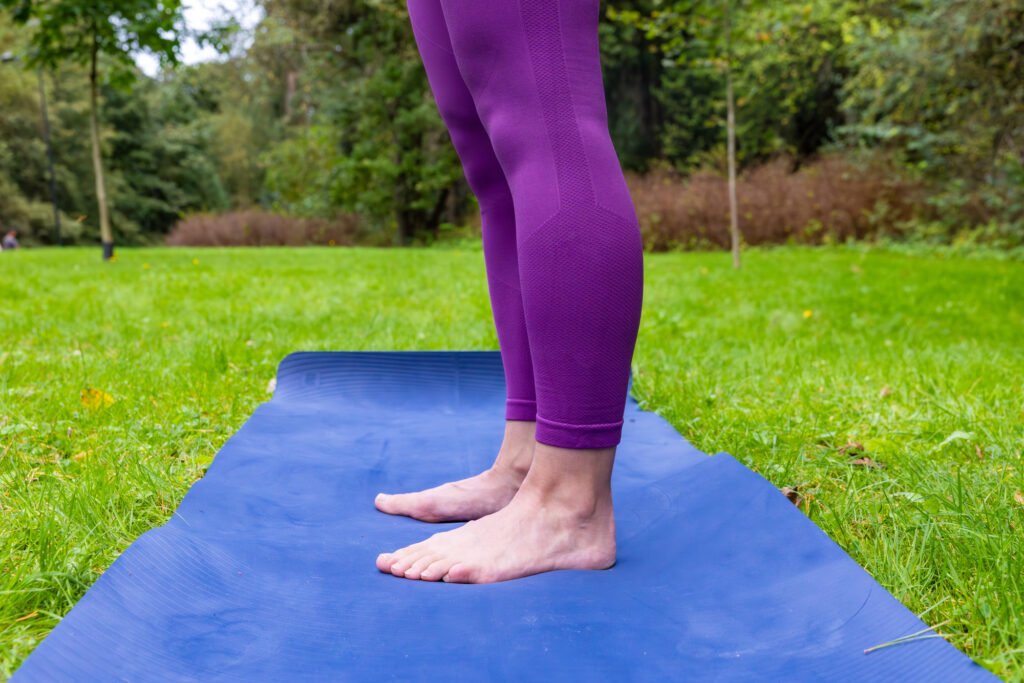
Notice Your Feet
Stand comfortably with both feet on the floor.
Without changing your posture, notice where your feet meet the ground.
Can you feel your heels?
Your toes?
Does one foot seem to carry more weight?
Now slowly shift your weight from side to side.
What changes?
Not to improve anything.
Simply to notice.
Follow One Breath
Take one slow, unhurried breath.
Where do you feel it most clearly?
Your chest?
Your ribs?
Your abdomen?
Your back?
As you exhale, notice what changes.
Nothing more.
Just one breath.
Notice Through Touch
Rest one hand gently on your forearm.
Notice the warmth of your hand.
The texture of your skin.
The gentle pressure beneath your palm.
What changes when your attention settles there?
Again, there is nothing to achieve.
Only something to notice.

More Than a Different Way to Move
The benefits of somatic yoga aren’t limited to what happens on the mat.
Over time, many people begin recognizing patterns earlier. They notice tension before it becomes pain, stress before it becomes overwhelm, or the need for movement before stiffness sets in. They may find themselves taking a deeper breath during a difficult conversation or recognizing that a short walk feels more supportive than pushing through fatigue.
These aren’t special abilities. They are capacities we all possess.
Somatic practice simply gives us opportunities to become more familiar with them.
Whether through yoga, dance, walking, breathwork, creative movement, or simply pausing long enough to notice your feet on the ground, the invitation remains remarkably simple:
Your body has been communicating all along.
Somatic yoga doesn’t ask you to become someone different.
It simply invites you to notice—and trust—the wisdom that has been there from the beginning.