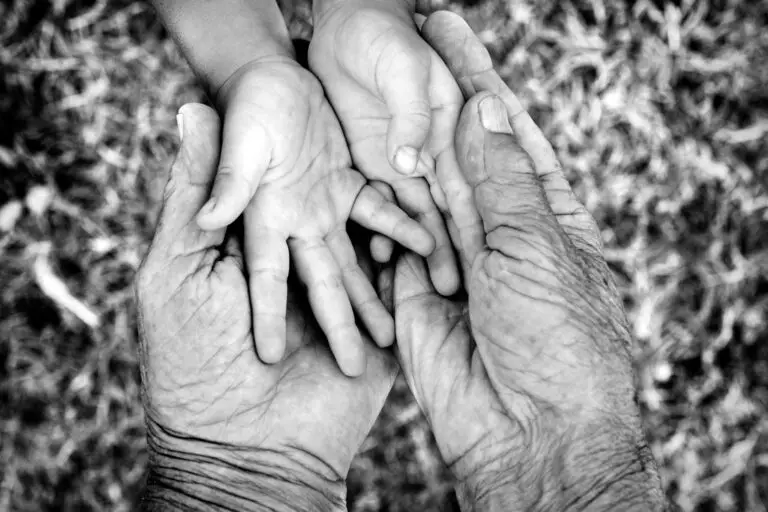

There are many ways to remember the people who came before us.
Sometimes remembrance is intentional: visiting a grave, telling a familiar story, looking through old photographs, or keeping an object connected to someone who came before.
Other times, it catches us by surprise.
A song comes on. Someone uses a familiar expression. A certain flower blooms. A box that has been sitting unopened for years turns up in a closet. Suddenly, a person, a story, or a part of our family history is present in our thoughts again.
What comes with that can vary just as much. Some memories bring affection, pride, gratitude, or a sense of belonging. Others bring grief, anger, uncertainty, or pain. Many family histories hold both strength and struggle, sometimes in the same story. And there may be people we know only through fragments, or whose stories have been lost altogether.
Across cultures and throughout history, people have created rituals and traditions for remembering the dead, honoring ancestors, and maintaining connections with family lineage. Some of those practices are deeply religious or spiritual. Others live through storytelling, objects, music, traditions, names, places, and everyday acts of remembrance.
Ancestor oracle cards offer another way to explore that connection.
For some people, drawing an ancestral oracle card is part of a spiritual relationship with ancestors. Others use the cards to explore memories, family stories, inherited strengths, cultural history, difficult patterns, or questions about where they come from.
And some people find meaning somewhere in between, without needing to define exactly what is happening.
There is no single way to approach ancestral connection. It does not require admiration for everyone who came before us, nor does remembering someone require excusing harm they may have caused.
An ancestor oracle card can simply offer a place to begin.
What Are Ancestor Oracle Cards?
Ancestor oracle cards, sometimes called ancestral oracle cards, are decks created around themes of ancestry, family lineage, inherited wisdom, remembrance, healing, and connection with those who came before us.
Like other oracle decks, they do not follow a single established system. The creator determines the structure of the deck, its imagery, themes, and interpretations. Some decks draw heavily on spiritual ideas about ancestral guidance, while others include themes that can also be explored through reflection, memory, symbolism, and self-inquiry.
Two examples are Ancestral Healing Oracle by Inna Segal, illustrated by Jena Dellagrottaglia, and Secrets of the Ancestors Oracle by Abiola Abrams. Both explore ancestry, although they offer different ways into the subject. Secrets of the Ancestors, for example, explicitly explores family lineage and modern ancestral veneration, while Ancestral Healing Oracle offers guidance and practices for exploring inherited patterns, healing, and personal growth.
A card might depict an archetype, place, object, element of nature, or symbolic image accompanied by a message or question. The guidebook offers the creator’s interpretation, but that does not have to be the end of the experience.
Someone might draw a card and immediately think of a particular person. An image might stir a memory or make a family story look different. A phrase might raise a question about culture, identity, or something that seems to repeat across generations.
For someone who approaches the cards spiritually, the experience may have another dimension entirely.
The card can be guidance, a prompt, a symbol, a catalyst for memory, or simply prompt reflection.
For a broader introduction to oracle decks and reflective card practices, see How to Use Oracle Cards for Reflection, Ritual, and Self-Inquiry.
Why Connect With Ancestors?
There are many reasons people become curious about those who came before them.
Sometimes it begins with someone they knew and miss. Sometimes it begins with a family story that never quite made sense, a cultural tradition they want to understand more deeply, or a question about how their family arrived where they are today.
For some people, ancestral connection offers a sense of belonging and continuity. Within religious and spiritual traditions that maintain active relationships with ancestors, it may also include prayer, offerings, guidance, protection, or other forms of ancestral veneration.
For others, the connection is less explicitly spiritual. It might mean learning where a surname came from, discovering why an older relative valued something so strongly, recognizing a familiar gesture in another generation, or becoming curious about a place that appears repeatedly in family history.
Ancestor cards can also bring attention to what has traveled through a family: strengths, patterns, values, losses, traditions, ways of relating, or ways of responding to the world.
Those questions sometimes overlap with contemporary conversations about ancestral healing, which can include both painful inheritance and the strengths, relationships, and cultural resources that travel across generations. For a deeper exploration of what ancestral healing means, including intergenerational trauma, collective trauma, strengths, and a yoga-informed perspective, see What Is Ancestral Healing? Trauma, Strength & What We Inherit.
The oracle card has a different job.
It does not need to explain the past or tell us what happened generations ago.
Sometimes it simply gives us something new to wonder about.
Autumn, Halloween & a Season of Remembrance
There is a reason ancestry and remembrance can feel especially present as October turns toward November.
The ancient Gaelic festival of Samhain marked a seasonal transition around the end of harvest and beginning of winter. Traditions associated with Samhain developed over many centuries, including beliefs and stories concerning spirits and the relationship between this world and the Otherworld.
Christian observances also shaped this time of year. All Hallows’ Eve, followed by All Saints’ Day on November 1 and All Souls’ Day on November 2, brought their own traditions of remembering saints and the faithful departed. The word Halloween itself developed from All Hallows’ Eve.
Other distinct traditions of remembrance happen near this time of year, including Día de los Muertos in Mexico and communities throughout the diaspora. Elsewhere and at other times of year, traditions such as the Japanese Buddhist observance of Obon create their own ways of honoring those who have died. Each tradition arises from particular cultural, religious, and historical contexts.
What is interesting here is not the idea that all cultures share one universal ancestor ritual. It is that remembrance has taken so many forms.
People have found ways to give memory a place in ordinary life and sometimes to set aside particular times when attention turns deliberately toward those who came before.
An ancestor oracle deck can become one contemporary way of creating that moment.
Ancestry Can Lead Us Into History
Following a family story backward often leads somewhere beyond the family itself.
A surname leads to a place. An old letter contains a reference nobody understands anymore. A language disappeared between generations. A relative’s occupation makes more sense after learning what was happening economically at the time. A tradition that seemed like simply “what our family does” turns out to have a much longer cultural history.
Sometimes family history also reveals how little we know about the history around us.
In Minnesota, for example, understanding place includes recognizing the long and continuing histories of the Dakȟóta Oyáte and Anishinaabe peoples, whose relationships with these lands long precede the establishment of the state.
Learning that history is different from claiming someone else’s ancestors or cultural practices as our own. It can instead widen our awareness of the places we inhabit and the histories our own family stories eventually intersected.
An oracle card will not tell us that history, but it might make us curious enough to go looking for it.
You Don’t Have to Know Your Family Tree
Some people can trace generations of relatives through names, records, photographs, and stories.
Others have enormous blank spaces.
Adoption, estrangement, migration, displacement, slavery, colonization, war, family secrecy, lost records, and countless other circumstances can interrupt knowledge of a lineage. Sometimes information simply disappears as generations pass.
Not knowing does not have to exclude someone from ancestral reflection.
A card can be approached without attaching it to a particular named person. Someone might reflect on a branch of their family, a cultural lineage, an unknown ancestor, or simply the many lives that existed before their own.
It is also possible for a card to bring attention to the limits of what can be known.
Not every blank needs to be filled.
Sometimes curiosity can remain curiosity.
What Can an Ancestor Oracle Card Bring Forward?
This is where the practice can become surprising.
A card showing an elaborately dressed figure might bring to mind someone who took enormous pleasure in clothing and personal style. A card featuring hands might recall a relative who built things, played an instrument, sewed, painted, repaired cars, or worked with the same tools for decades.
A word might remind someone of an expression they heard throughout childhood without ever wondering where it came from.
An image of water could bring a particular place to mind. A card about voice might raise questions about whose opinions were welcomed in a family and whose were not. A symbol might remind someone of a religious tradition they grew up around, rejected, returned to, or never fully understood.
A card can also bring forward something difficult.
It might remind someone of a relationship that caused real harm. It may stir anger, grief, ambivalence, or a question about a family pattern they do not want to continue. Drawing an ancestor card does not require turning every person in a lineage into a source of wisdom.
And sometimes the card points toward someone who is still here.
It may inspire a question for an older relative, family friend, sibling, or other person who remembers something we do not.
The card does not necessarily provide an answer.
Sometimes it provides a thread.
That thread might lead to a conversation, an old document, a historical rabbit hole, a piece of music, a hometown, a tradition, or something that has been sitting in a drawer for decades.
Sometimes it simply changes what we notice.
Spiritual Guidance, Reflection, or Somewhere in Between
People approach ancestral oracle cards with very different beliefs.
Within some traditions and spiritual practices, relationships with ancestors are understood as ongoing. Drawing a card may be experienced as receiving guidance, deepening an existing spiritual practice, or creating intentional space for ancestral connection.
Someone else may understand the same experience through intuition, memory, association, imagination, or reflection.
Neither approach needs to be imposed on the other.
An oracle card can also be meaningful without requiring someone to decide exactly where an insight came from. A particular image might arrive at just the right moment. A memory might surface unexpectedly. Something in the guidebook may resonate deeply, or not at all.
There is room to approach that experience with curiosity.
And oracle cards are certainly not necessary for connecting with ancestry. Prayer, meditation, genealogy, storytelling, art, music, visits to meaningful places, cultural traditions, or simply spending time with a memory can offer other ways of engaging with those who came before.
The card is one possible doorway.
Tiny Ritual: How to Use Ancestral Oracle Cards for Connection
This practice can be simple. Ten quiet minutes is enough.
Choose a place where you can spend a few minutes without needing to rush. If you would like, bring one object that connects you with family, culture, place, or remembrance. It might be something inherited, something handmade, a flower, a letter, a piece of fabric, a meaningful book, or another object that feels appropriate.
Or simply bring the deck.
Settle into a comfortable position and take a few unhurried breaths.
Bring to mind a person, family line, cultural history, unknown ancestor, or question about what came before you. There is no need to manufacture a particular feeling toward it.
Then choose a question. Some examples:
What would I like to understand more deeply?
What strength has traveled through my family or community?
What story deserves more of my curiosity?
What am I noticing about what came before me?
What feels important to remember or reconsider?
Shuffle the deck and draw one card.
Before reaching for the guidebook, spend a moment with the card itself.
Notice where your attention goes first. Perhaps it is a figure, expression, landscape, object, word, color, or small detail in the illustration. Notice what associations arise before deciding what the card is supposed to mean.
Then read the interpretation in the guidebook.
What changes when the creator’s words meet your own response to the card?
Something may resonate immediately. Something may surprise you. The card may bring up a memory, question, emotion, resistance, or idea you want to explore further.
Or it may not.
There is no need to manufacture significance.
If a thread appears, follow it as far as feels useful. Write for a few minutes. Ask someone a question. Look up a place or historical event. Find an old letter. Listen to a piece of music. Learn more about a tradition. Sit quietly with whatever came forward.
Or leave the card somewhere visible and return to it later.
When the ritual feels complete, return the card to the deck or leave it out for a while. Take another breath and notice whether there is anything you want to remember, explore, question, or simply leave with the card.
Staying Curious About What Came Before
Family histories rarely resolve themselves into simple stories.
There may be people we admire, people we miss, people we barely know, and people whose choices caused lasting harm. There may be strengths we recognize immediately, traditions we want to reclaim, patterns we want to understand differently, and parts of the story that will always remain unknown.
An ancestor oracle card cannot tell us what to make of all of that.
What it can offer is a prompt: an image, a question, an unexpected association, a reason to look more closely at something we might otherwise have passed by.
Sometimes that leads toward family history or ancestral healing. Sometimes it leads toward spiritual practice. Sometimes it raises a question for someone who is still here.
And sometimes the most interesting thing a card offers is simply a new way of looking at what came before—and wondering where the thread might lead next.