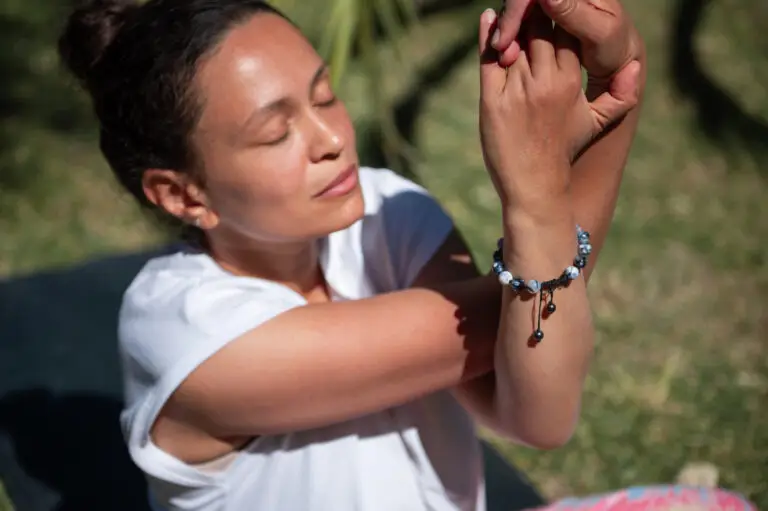

What comes to mind when you hear the word yoga?
For many people, it’s movement. Stretching. Beautiful poses. A peaceful class at a local studio. Perhaps it’s a way to improve flexibility, build strength, or manage stress.
All of those experiences are valid. For many of us in the West, movement is how we’re first introduced to yoga.
That was true for me, too.
I was fortunate, though, to begin practicing with teachers who gently wove yoga philosophy into their classes. From my very first class, I was introduced to ahimsa, the principle of non-harming. Even then, I had an awareness there was something deeper than movement taking place.
Over the years, through study, practice, and the guidance of many thoughtful teachers, I came to appreciate the remarkable depth and richness of yoga philosophy. What began as movement gradually became a way of understanding myself, my relationships, and the world around me.
Yoga has a way of revealing itself over time. Few people encounter the full richness of the tradition all at once. As we grow and our lives unfold, different teachings often begin to resonate in new ways.
Yoga Is More Than a Physical Practice
In much of the Western world, yoga has become closely associated with physical postures. While movement can be a deeply meaningful part of practice, it represents only one aspect of a much broader tradition.
At its heart, yoga offers a way of living. It invites us to explore how we relate to ourselves, to others, and to the world around us. It encourages awareness rather than autopilot, compassion rather than judgment, and presence rather than constant distraction.
This broader understanding of yoga has been explored for centuries.
The Eight Limbs of Yoga are introduced in the Yoga Sutras of Patañjali, one of the foundational texts of yoga philosophy. Rather than describing yoga as simply a physical practice, the Yoga Sutras offer a framework for living with greater awareness, intention, and connection.
The Eight Limbs have inspired centuries of study, reflection, and practice. Entire books have been written about each limb, and even individual principles like ahimsa or svadhyaya. This article isn’t meant to be a comprehensive exploration. Instead, think of it as an introduction: a way to become familiar with the landscape before choosing where you might like to explore more deeply.
The Eight Limbs are interconnected aspects of yoga practice that support and inform one another throughout life. Together, they offer a way of understanding yoga not simply as something we do, but as a way of living.
The Eight Limbs of Yoga
The Eight Limbs describe different dimensions of yoga practice. The first two limbs—the Yamas and Niyamas—each include five guiding principles that shape how we relate to others and to ourselves. The remaining six limbs describe practices that cultivate awareness through the body, breath, senses, attention, meditation, and ultimately, a deep sense of connection.
1. Yama: How We Relate to Others
The Yamas are five ethical principles that guide our relationships with other people and the world around us. Rather than a list of rules, they’re invitations to live with greater awareness, compassion, and integrity.
The five Yamas are:
Ahimsa (Non-Harming)
Often considered the foundation of yoga philosophy, ahimsa is far richer than simply “being nice.” It invites us to reduce harm wherever we can—in our actions, our words, and even our thoughts.
In everyday life, that might mean speaking with kindness during a difficult conversation, extending compassion to someone who sees the world differently, or noticing when your inner dialogue becomes harsher than you would ever speak to a friend.
Satya (Truthfulness)
Satya encourages honesty, authenticity, and integrity. Sometimes that means telling the truth to others. Just as often, it means acknowledging the truth within ourselves.
It may look like admitting you’re exhausted instead of pretending you’re fine, recognizing when you’re living out of alignment with your values, or having the courage to express what matters to you with both honesty and compassion.
Asteya (Non-Stealing)
While often understood literally, asteya also invites us to consider the subtler ways we take more than we need. It encourages gratitude, generosity, and respect for the time, energy, ideas, and contributions of others.
In practice, it may also invite us to notice when comparison steals our contentment or when busyness steals our presence.
Brahmacharya (Wise Use of Energy)
Like many ideas in yoga philosophy, brahmacharya has been interpreted in different ways throughout history. Today, many teachers understand it as the wise stewardship of our energy.
Rather than scattering our attention in countless directions, brahmacharya asks what truly deserves our time, focus, and care. It might look like setting healthy boundaries, limiting distractions, or making space for the people and practices that genuinely nourish us.
Aparigraha (Non-Grasping)
Aparigraha invites us to loosen our grip—on possessions, expectations, identities, or outcomes. It reminds us that peace isn’t always found in having more, but sometimes in holding things more gently.
That doesn’t mean we stop caring about our goals. It means learning to pursue them without believing our worth depends upon the outcome.
2. Niyama: How We Relate to Ourselves
If the Yamas guide our relationships with others, the Niyamas invite us inward. These five personal practices encourage self-awareness, growth, and a compassionate relationship with ourselves.
The five Niyamas are:
Saucha (Purity or Clarity)
Often translated as purity, saucha can also be understood as cultivating clarity. This may include caring for our bodies, creating environments that support well-being, or noticing what brings greater clarity to our minds and hearts.
It’s less about perfection and more about creating space for what helps us flourish.
Santosha (Contentment)
Santosha is the practice of contentment. Not because life is perfect, but because we learn to appreciate what is present while remaining open to growth.
It reminds us that gratitude and aspiration can exist together.
Tapas (Disciplined Practice)
Tapas is the steady commitment that allows meaningful change to happen. It’s less about intensity than consistency.
Whether it’s returning to your breath, keeping a promise to yourself, or showing up for practice on an ordinary Tuesday, tapas reminds us that transformation often happens through small acts repeated over time.
Svadhyaya (Self-Study)
One of the most beloved ideas in yoga philosophy, svadhyaya invites us to become curious observers of ourselves.
It asks us to notice our patterns, beliefs, habits, reactions, and stories and to understand them more deeply. Genuine self-awareness often becomes the beginning of meaningful change.
Ishvara Pranidhana (Surrender)
This principle has been understood in many different ways across yoga traditions. For some, it expresses devotion to the Divine. For others, it reflects the practice of letting go of the need to control everything.
In everyday life, it may look like doing your best while releasing the illusion that every outcome is yours to manage.
3. Asana: Physical Postures
Asana refers to the physical postures or poses most people associate with yoga.
While movement is often where people first encounter yoga, it is only one of the Eight Limbs. Different yoga traditions understand the purpose of asana in different ways. Today, many people experience it as a practice that cultivates strength, flexibility, steadiness, and embodied awareness.
In practice, this might look like moving with awareness rather than rushing through a sequence, noticing how your body feels instead of striving for the “perfect” pose, or simply taking a few mindful stretches after a long day.
4. Pranayama: Breath
Pranayama refers to intentional breathing practices. Prana is often translated as “life force” or “vital energy” and ayama as “control,” “extension,” or “expansion.”
In yoga, the breath is understood as a bridge between body and mind. Long before modern science began studying slow breathing and the nervous system, yoga practitioners recognized the breath as a powerful tool for cultivating steadiness and awareness.
In everyday life, this might look like pausing for a few slow breaths before an important conversation, using a calming breathing practice during times of stress, or simply noticing your breath as an anchor when your mind begins to race.
5. Pratyahara: Turning Inward
Pratyahara is often translated as “withdrawal of the senses” or “turning inward.”
Rather than withdrawing from life, it invites us to become less reactive to constant stimulation and more aware of our inner experience.
This might look like taking a walk without your phone, sitting quietly for a few moments before beginning your day, or noticing how different environments affect your mood, energy, and nervous system.
6. Dharana: Concentration
Dharana refers to focused attention or concentration.
Every time you gently return your attention—to your breath, a conversation, or a creative project—you are strengthening your capacity to focus.
You might practice dharana by giving one task your full attention, listening deeply without planning your response, or repeatedly bringing your awareness back whenever your mind wanders.
7. Dhyana: Meditation
Dhyana refers to meditation or sustained awareness.
Rather than forcing the mind to become quiet, dhyana points toward an ongoing quality of presence that develops through practice.
For many people, this looks like sitting in meditation, but it can also emerge during quiet moments of walking, prayer, mindful movement, or simply resting in attentive awareness.
8. Samadhi: Deep Connection
Samadhi is often described as a state of profound peace, unity, or deep connection.
While difficult to capture in a single English word, it points toward moments when our usual sense of separation softens and we experience a deep sense of wholeness.
These moments can’t be forced, but many people recognize glimpses of them—feeling completely absorbed in music, standing in awe of nature, losing themselves in creative expression, or experiencing an unexpected sense of connection during meditation or prayer.
More Than What Happens on the Mat
When viewed together, the Eight Limbs paint a very different picture of yoga than many of us first encounter.
Movement matters. Breath matters. Meditation matters.
But so do kindness, honesty, self-reflection, contentment, focus, and compassion.
Yoga becomes less about mastering poses and more about practicing how we live.
Whether yoga is already an important part of your life or you’re simply curious about what lies beyond the poses, I hope this article offers a glimpse into why so many people continue to study and practice this tradition.
The Eight Limbs aren’t a checklist to complete or a philosophy to memorize. They’re one way of exploring what it means to live with greater awareness, compassion, and connection.
Reflection
What comes to mind now when you hear the word yoga? Has that understanding changed as you’ve read this article?
For Further Exploration
If you’d like to continue exploring yoga philosophy, these are wonderful places to begin.
Books
- The Yoga Sutras of Patañjali (many excellent translations are available)
- The Heart of Yoga — T.K.V. Desikachar
- The Wisdom of Yoga — Stephen Cope
- The Yamas & Niyamas — Deborah Adele