If you’ve ever finally had time to rest, only to feel more restless, you’re not alone.
This is a common experience, especially for people whose systems have adapted to ongoing stress. Practices like Yin Yoga offer a more gradual way to access rest, without forcing stillness.
When Rest Doesn’t Feel Restful
It is not uncommon to finally have time to rest, only to find that the experience is unexpectedly uncomfortable.
Instead of settling:
- the mind becomes more active
- the body feels restless
- there may be a subtle sense that something is not quite right
This experience is often interpreted as anxiety or simply not being able to relax. In practice, it may be more accurately understood as a reflection of how the nervous system has adapted to ongoing stress (Streeter et al., 2012).
For many people, the challenge is not a lack of effort.
It is a lack of familiarity with stillness.
Why Stillness Can Feel Difficult
When the body has been operating under sustained demand, it becomes oriented toward activity.
- attention is directed outward
- tasks are continuously processed
- the system remains prepared to respond
In this context, stillness can feel unfamiliar or even slightly uncomfortable.
Without a clear point of focus, attention tends to move quickly, and internal sensations may become more noticeable.
You may notice:
- thoughts becoming more prominent
- internal sensations becoming more noticeable
- a general sense of restlessness
This helps explain why practices that rely on complete stillness—such as meditation or Yoga Nidra—can feel difficult to access, even when they are known to be beneficial.
Where Yin Yoga Fits
Yin Yoga offers a different entry point into rest.
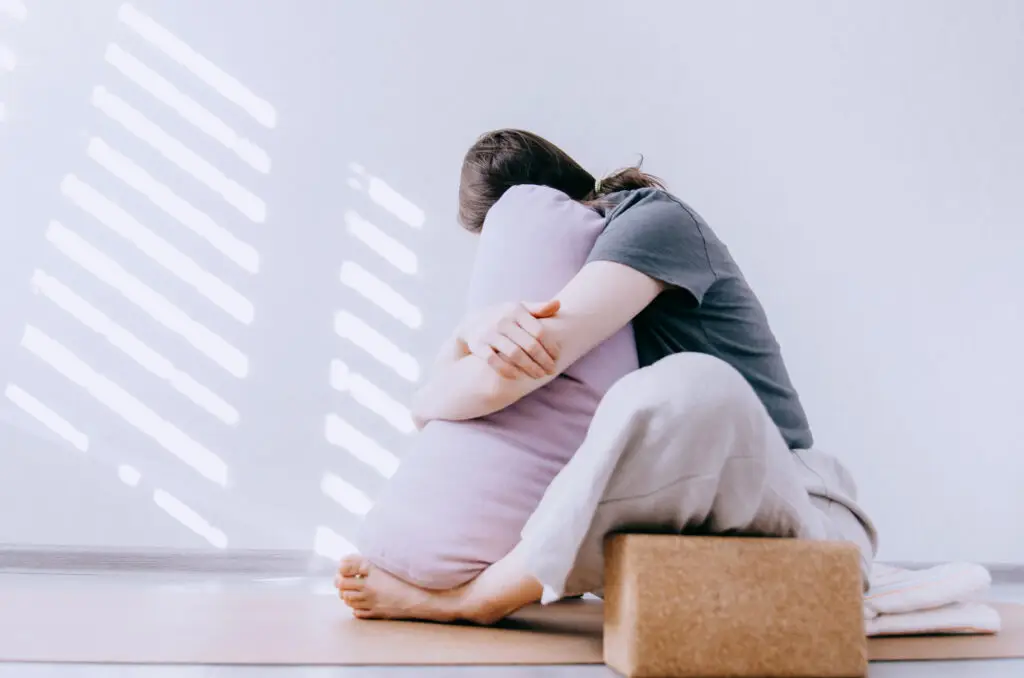
It is a slow, meditative style of practice in which poses are held for several minutes, typically with the support of props. Muscular effort is minimized, and the emphasis is placed on allowing the body to gradually settle.
Rather than moving directly into complete stillness, Yin provides a structured environment in which the body can slow down while attention remains gently engaged.
This makes it particularly relevant for individuals who find that rest feels uncomfortable or difficult to sustain.
The Role of Fascia in Yin Yoga
Yin Yoga is often associated with its effects on connective tissue, particularly fascia.
Fascia is a network of tissue that surrounds and interweaves with muscles, organs, and other structures throughout the body. It plays a role in both mechanical support and sensory awareness.
Unlike muscle tissue, fascia responds more slowly, which is one reason Yin Yoga uses longer-held, passive positions.
Sustained, low-intensity stretching may influence connective tissue over time, including:
- hydration
- elasticity
- adaptability
(Schleip & Müller, 2013)
Fascial tissue also contains a high density of sensory receptors related to pressure, stretch, and internal awareness, which may contribute to the calming effects of slower practices (Langevin, 2006).
Sensation as a Point of Focus
One of the defining characteristics of Yin Yoga is the presence of mild, sustained sensation.
This may include:
- gentle pressure
- stretch
- contact with the ground
The intensity is intentionally moderate—often described as the edge of discomfort without entering into pain.
This level of sensation serves as a natural anchor for attention.
Instead of trying to quiet the mind directly, attention is oriented toward what is being felt in the body.
For many people, this creates a more accessible form of stillness. The body is quiet and supported, but the experience is not empty.
This process is closely related to interoception (awareness of internal bodily sensation), which has been associated with improved emotional regulation and reduced anxiety (Mehling et al., 2012).
How This Supports Nervous System Regulation
From a physiological perspective, slower, supported practices such as Yin Yoga are associated with shifts in the autonomic nervous system.
These practices have been linked to:
- increased parasympathetic activity (rest-and-recover)
- decreased sympathetic activation (fight-or-flight)
(Streeter et al., 2012)
These shifts support the body’s ability to move out of a chronically activated state and into a more regulated, restorative mode.
Within yoga therapy, this is understood as improving the system’s flexibility—its ability to move between activation and rest more effectively.
What Research Suggests About Yin Yoga
Research specifically on Yin Yoga is still emerging, but early findings are consistent with broader yoga literature.
A randomized controlled study found:
- reductions in stress
- reductions in anxiety
- reductions in depressive symptoms
- improvements in interoceptive awareness
(Herbert et al., 2018)
More broadly, systematic reviews and meta-analyses have found consistent associations between yoga and reduced stress and anxiety, particularly when practices include slower movement, breath regulation, and attention-based components (Cramer et al., 2014).
Yin Yoga and Sleep
The relationship between Yin Yoga and sleep is best understood through its effects on regulation.
Sleep difficulties are often associated with persistent activation in the nervous system. When the body remains in a heightened state, it can be difficult to transition into sleep.
Practices that support gradual downregulation—rather than forcing immediate stillness—can help bridge this gap.
By combining:
- supported positions
- reduced muscular effort
- sustained attention to sensation
Yin Yoga creates conditions that may support the transition from activation into rest.
This aligns with research showing that yoga can improve:
- sleep quality
- time to fall asleep
(Wang et al., 2020)
A Simple Way to Begin
A simple way to begin exploring Yin Yoga is to choose one supported position and remain there for several minutes.
Allow the body to be relatively passive, and bring attention to areas of:
- gentle stretch
- pressure
- contact with the ground
There is no need to change the experience. The emphasis is on allowing sensation to be present without reacting to it.
A Different Way to Understand Rest
Rest is often described as something that should be immediately accessible.
In practice, it is sometimes a capacity that develops gradually.
When rest feels uncomfortable, it is not necessarily a sign that something is wrong. It may reflect a missing step in the process of shifting from sustained activation into deeper states of recovery.
Yin Yoga offers one way of working within that process.
A Steady Approach to Change
As with other areas of mind-body health, change tends to be incremental.
The goal is not to force the system into stillness, but to create conditions in which it can move there more naturally.
Within the broader context of yoga therapy, practices like Yin Yoga are best understood as complementary tools. They do not replace other forms of care, but they can support regulation, improve sleep, and increase comfort with stillness in a gradual and sustainable way.
References
Cramer, H., Lauche, R., Haller, H., & Dobos, G. (2014). Yoga as an antihypertensive lifestyle therapy: A systematic review and meta-analysis. Complementary Therapies in Medicine, 22(3), 447–455.
Herbert, C., et al. (2018). Effects of Yin Yoga on psychological health and interoceptive awareness. Frontiers in Human Neuroscience.
Langevin, H. M. (2006). Connective tissue: A body-wide signaling network? Medical Hypotheses, 66(6), 1074–1077.
Mehling, W. E., et al. (2012). The Multidimensional Assessment of Interoceptive Awareness (MAIA). PLoS ONE, 7(11), e48230.
Schleip, R., & Müller, D. G. (2013). Training principles for fascial connective tissues. Journal of Bodywork and Movement Therapies, 17(1), 103–115.
Streeter, C. C., et al. (2012). Effects of yoga on the autonomic nervous system and stress response. Medical Hypotheses, 78(5), 571–579.
Wang, F., et al. (2020). The effect of meditative movement on sleep quality. Sleep Medicine Reviews, 52, 101305.
If rest has felt difficult to access, you might benefit from a more gradual approach. You can explore upcoming workshops designed to support this transition here.